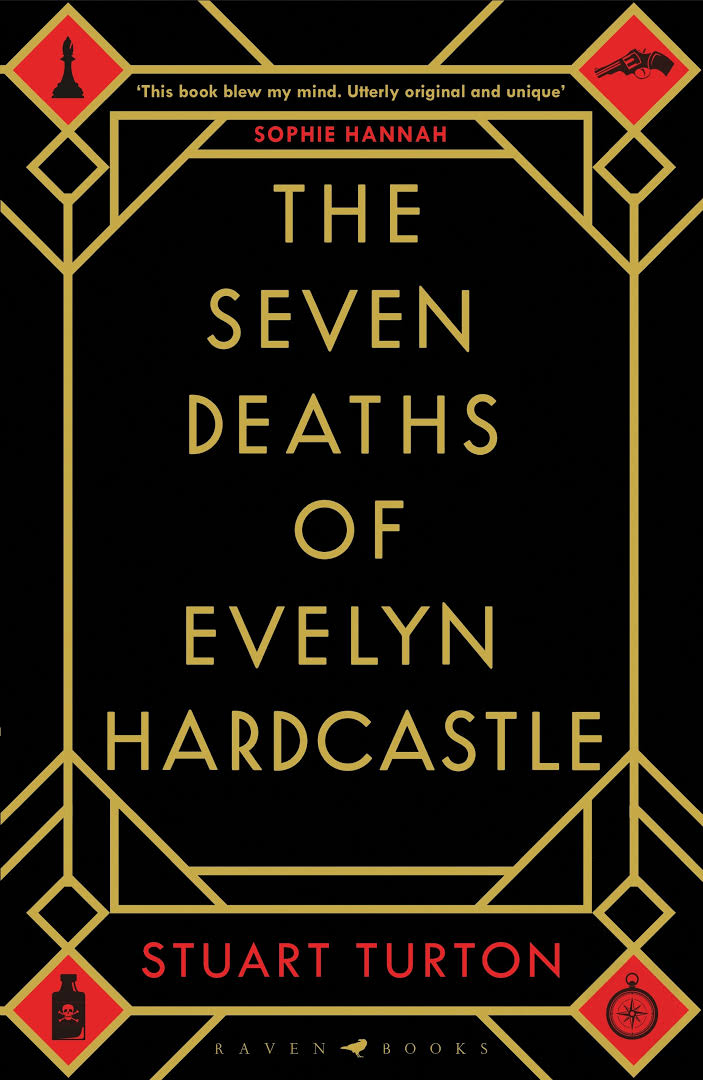
Stuart Turton: The Seven Deaths of Evelyn Hardcastle

Crime fascinates me. Not so much in the true crime sense – my automatic reaction to the idea of “true crime” stories and podcasts is that they feel voyeuristic and sensationalist. But the idea of solving crimes fascinates me. I have thus enjoyed crime fiction for quite some time. Alas, I haven’t read proper crime fiction in a while. I used to devour airport-thrillers like those written by Jeffrey Deaver but, barring occasional dalliances, haven’t properly engaged with the genre since roughly 2014. I’m working to change this, slowly making my way through the John Rebus series by Ian Rankin. To this end, a friend gifted me a copy of The Seven Deaths of Evelyn Hardcastle by Stuart Turton.

Overall, the novel is great fun. The central premise is this: Aiden Bishop wakes up in a body that isn’t his own, and is tasked by a stranger in a plague doctor costume to solve the murder of heiress Evelyn Hardcastle at a party. Each day over the following eight days, he will hop into the body of a different party guest and must use whatever they have to offer in order to solve the murder. If he does not solve it, the whole thing resets and he must start again with no memories of his previous eight days. It’s an original and quite intriguing premise.

The estate of the Hardcastle family, Blackheath Manor, is very Gothic: a sprawling mansion, whose slow descent into ruin mirrors the hard times on which the Hardcastles have fallen. The bodies into which Aiden’s consciousness is transported are owned by suitably miserable characters. It’s told in a disordered fashion, each identity and different day recorded at the beginning of the chapter. All of this is very well-handled, the atmosphere of the novel is brooding and menacing, and the twists and turns deftly managed. The identity of the murderer I won’t reveal, but none of it played out as I expected it to which made for an enjoyable and engaging reading experience.

I did, however, take issue with the set-up. Not the idea of a body-hopping time-loop, per se, but the way in which that idea was utilised. Turton uses a man in a plague doctor costume to inform Bishop of the situation: that he has eight days, and eight bodies, with which to solve the death of the titular heiress, and he is in competition with two others. On its own, that’s a scintillating idea. A spooky guy forcing some other guy to solve a murder in a Gothic mansion? Sign me up. Great fun.

But. All is not as it seems. Turton later reveals that a time-loop prison company employs the plague doctor. Blackheath Manor is but one of thousands of time-loop simulations to which prisoners are condemned, their release contingent on them resolving whatever situation it is in which they find themselves. In this case, the condemned prisoner is Aiden’s love interest, Anna. She was sentenced to Blackheath Manor for killing his brother, and he has ended up in the Manor because he chased her in there to get his revenge. But, over the many years of the simulation, they have forgotten who they were on the outside. This is, of course, by design – the time-loops rehabilitate the prisoners into acceptable members of society, memory restoration optional upon release. Unfortunately, what should be a shocking twist doesn’t land with much impact. Given that Aiden knows nothing of his past on the outside, and neither does Anna, then it doesn’t really matter. Had Aiden kept his memories of his former life and still fallen in love with Anna, whose face could now be different to that which she’d worn before being imprisoned, and then been told his love interest was originally a murderer, that would have had more impact. Or it might have been obvious, depending on a given reader’s perceptiveness.

So, the novel hangs on two frameworks. One is a Gothic-horror-murder-mystery, the other a sci-fi dystopia for the ages, both mixed together into an intriguing plot that mostly works. Mostly. I feel as if Bishop and the plague doctor could have simply been a hero vs villain without the need for the plague doctor to be an employee in a prison system. As soon as we learn the plague doctor’s real name and his purpose, his mystique is gone. The menacing atmosphere of the novel is punctured, never to be fully recaptured. On his own, the mysterious plague doctor could have stood as a terrifying, unknowable enemy – an Iago manipulating Aiden for reasons never fully explained. Is Blackheath Manor a form of Hell? Purgatory? A nightmare? Is it real? We would never know, and so the plague doctor could rightfully take his place in the ranks of epic villains of literature. Instead, he is merely a jobsworth prison guard.

The same applies to the time-loop prison itself. What a concept! What a fantastic premise for a dystopia. There’s a whole universe here that Turton ignores: a gigantic cosmic playground in which we, the reader, see only a small game played out in one corner. Just on its own, a time-loop prison to which murderers are condemned until they have forgotten their former identities is a horrific punishment against which there would be no end of resistance. This is a fertile premise, offering potential commentary on prison reform and government corruption to virtual reality vs actual reality, AI problems, and more besides. What Turton does with it is an interesting use of the idea, but a limited one. Ultimately, it felt to me as if it doesn’t mesh well with the idea of a Gothic murder-mystery.

But don’t let this suggest that I didn’t enjoy it. This particular essay is more exploring a personal dissatisfaction than offering a proper critique. The time limit on the plot gives the story a frenetic pace, and Turton makes the reader really feel for Aiden, especially in some of his identities. Although we do not get much sense of who Aiden really is, the qualities of being a good man shine through regardless of his body. There is what feels like some unpleasant fatphobic language used when he is in the body of Lord Cecil Ravencourt, but I’m not qualified to comment on that issue; I just want to highlight as a legitimate shortcoming as opposed to my personal gripes. So, in sum, The Seven Deaths of Evelyn Hardcastle was a very entertaining read, regardless of my thoughts on its set-up.
Mayhem

I’m relatively new to horror films. As much as I’m a fan of horror comics like Hellblazer or Ghost Stories of an Antiquary by John Reppion, and horror comedies like Shaun of the Dead, I tend to shy away from actual horror films. I don’t really like being scared. I can’t fully explain the cognitive dissonance here. It might have something to do with the fact that the lurid illustrations of a Hellblazer comic are so clearly fantastical and fictional that, while they present dark corners of the human psyche, they tend to gross me out over actually scaring me.

But I want to explore more of horror cinema. I want to learn more about film and being a film critic, which makes ignoring as big and influential a genre as horror cinema unwise. So, with that in mind, I’ve set myself up with a Shudder account. But what film to watch first? I decided to play it safe with another horror-comedy: Mayhem, a story about a rage-inducing virus starring Steven Yeun and Samara Weaving.

You might think watching a horror film about a virus during a pandemic is a bad idea. The Andromeda Strain probably isn’t a wise choice, nor is Contagion. But Mayhem was a bad choice for different reasons. It’s a mostly middling film. The plot points are predictable, the characterisation is so thin as to be translucent, and if it’s going for any sort of social commentary then it does so very poorly. What it does well, however, is wreaking havoc and destruction. It’s a film that answers the question “Wouldn’t you just like to go apeshit for a while?” with a resounding “Yes, of course you would, so have fun.”

Steven Yeun plays Derek Cho, a beleaguered legal worker at a by-the-numbers corporate firm that’s not so much evil as amoral. Cho refuses to help with the case of Samara Weaving’s Melanie Cross, who gets angry. Cho calls security on Cross, but is shortly fired for a different reason. By this point, the whole of the corporation’s monolithic office tower has been infected with the “Red Eye Virus.” This is a virus which heightens stress hormones and removes personal and moral inhibitions from the infected. Chaos duly ensues.

And what glorious, glorious chaos it is. Security guards, feckless HR managers, reviled colleagues, all of them fall victim either to each other or to Derek and Melanie as they make their way to the top of the tower. People have their heads bashed in with hammers, pulped in photocopier trays, or for those who aren’t so full of anger, have sex with each other. At the top of the tower, assuming their positions offer them protection from the floors below, are the heads of the corporation. These people have the power to reverse Melanie’s case’s refusal and grant Derek his job back. Not that he likes his job: his narration over the opening scenes tells the audience that he has come to hate his work, but he needs it because of the economic benefits it confers on him. By contrast, Melanie is seeking an extension on a loan to ensure a relative’s house isn’t taken away by the bank. Our two protagonists originate from similar economic hardship, but arrive in the story in different places. Initially hating each other, they inevitably come to love each other. There is even a gratuitous sex scene.

Because that’s the thrust (ahem) of the film. What might in different hands have become an Erin Brockovich-esque heartbreaking tale of the underdog triumphing against a corporate behemoth is instead an excuse to watch corporate minions exercise their demons and smash up an office block for 90 minutes. Imagine The Belko Experiment but with more humour. The Red Eye Virus removes a victim’s inhibitions. So, in other words, it’s the equivalent of the Crossed virus from Garth Ennis’ series of the same name. In that series, the infected give in to their absolute worst impulses: murder, rape, nuclear holocaust, you name it, and the virus is transmitted by bodily fluids. Peak Garth Ennis. Mercifully, while Mayhem has absolutely no qualms about showing frustrated colleagues murdering each other with walking canes, staple guns, screwdrivers, and worse, nobody is shown to be sexually assaulted. People have sex openly and publicly, including our protagonists, but they steer well clear of on-screen rape. We should be thankful for that.

But ultimately, that’s all the film is – an excuse for violence and a sex scene. It has something approaching a commentary about cutthroat corporate culture, and the amorality of capitalism, but the thin characters and a tendency to revel in violence mean the commentary doesn’t get much breathing room. Melanie and Derek survive long enough for the quarantine team to have purged the virus from the building (would that such a feat could be accomplished in real life). Derek kills the CEO, takes over the company long enough to resolve Melanie’s case, and then resigns to enjoy the more artistic life he really wanted all along.

You might ask at this point: are there any consequences for his actions? Of course not. That would bring the comedic aspect crashing down. Derek reacts so violently to losing his job not just because of the virus, but because he’d believed it to be secure. He had, prior to the film’s start, ensured both his and his firm’s reputation on a legal precedent: those infected by the virus aren’t responsible for their actions while under its effects. This essentially makes the Mayhem the bastard offspring of The Purge and Office Space and not as good as either.

In short, because I’ve waffled on for 900 more words at this point than the film really deserves, Mayhem is reasonably fun if you enjoy comedy violence. Hate your office job and wish you could wreck the place without consequences? This film offers that cathartic escape. But there are much better films out there, and I look forward to whatever comes next on Shudder.

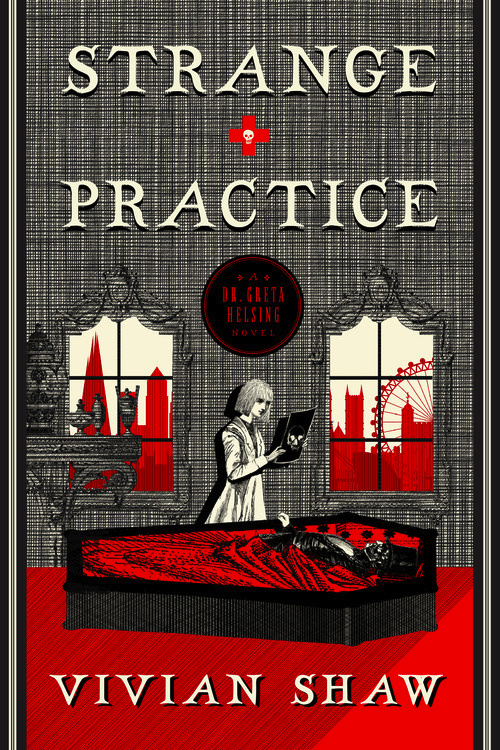
Vivian Shaw: “Strange Practice”

Round the corner from my house is a café that makes hot chocolate. That’s not unusual. But the way they make it is. They heat milk, pour it over chocolate chunks, add foam, and let you stir the chocolate in. It’s not the best way of making hot chocolate, but on a cold day, it’s still a tasty treat that does the trick of warming you up. I tell you this because the same is true of Vivian Shaw’s Strange Practice: it’s an inexpertly-made urban fantasy novel, but still enjoyable.

That might sound more condemnatory than I intend, so let me be clear: I enjoyed Strange Practice immensely, just as I enjoy the hot chocolate. But it is not without its flaws, and they are worth exploring.

Before delving into that, however, it’s worth summarising the plot. Greta Helsing (the family dropped the ‘van’ sometime in the 1930s) is a GP who looks after members of London’s hidden supernatural community. One of her colleagues is a witch. One of her best friends is a vampire named Lord Ruthven, who is lifted wholesale from John Polidori’s The Vampyre. When one of Ruthven’s friends Sir Francis Varney, similarly lifted from penny dreadful Varney the Vampire, is attacked, Ruthven and Greta become embroiled in a plot to exterminate the magical community. This plot is engineered by a malevolent primal force left over from the beginning of creation who, for reasons not strictly relevant, is currently housed in a disused underground railway mechanism from World War Two. It brainwashes priests from the nearby seminary into doing its bidding. When they aren’t killing random citizens and leaving rosaries on the body (leading tabloids to senstationally speculate about “The Rosary Ripper”) they go out with cross-shaped blades coated in a variety of tinctures and tonics designed to fatally harm magical creatures. Varney himself is stabbed with such a blade, and it is in healing him that Greta and Ruthven find themselves caught up in the evil being’s machinations. Along for the ride is August Cranswell, a human who works for the British Museum, and Fastitocalon, a demon with a penchant for accountancy. They duly defeat the evil being, with the help of Satan, but not before Fastitocalon has nobly sacrificed himself.

For me, the main flaw is that the characters are all, save for villain and the lackeys it brainwashes, incredibly and almost obsequiously nice. Not only does Greta leap into action to help Varney, a vampire she has never previously met, but so too do Fastitocalon and Cranswell fall over themselves to help as best they can in solving the main mystery. This is despite Fastitocalon’s respiratory difficulties, and the fact that Cranswell has hitherto never met any of the other protagonists. Furthermore, Greta’s involvement problematises her work at her surgery. But it’s OK, because her colleagues bend over backwards to help her keep it afloat. In amongst all this, she even finds time to help a family of ghouls look after their newest member, sick with a cough.

There’s nothing wrong with nice characters. But the niceness of Shaw’s protagonists is never given room to become a character flaw. Greta is stretched thin as a person – her responsibilities as a GP weigh heavily upon her, despite the slight income they afford her and the subsequent shabbiness of her lifestyle. But her colleagues step in and cover for her while she is off having an adventure, so these responsibilities never really hinder her. The only character who is harmed by their niceness is Fastitocalon. He rebuffs Greta’s concerns about his respiratory problems, but duly succumbs to them in the final battle.

Yet all is not lost, for almost immediately Satan himself comes riding to the rescue. Yes, you read that right, Satan appears from Hell and not only sends Fastitocalon down for some R&R (one can only imagine the restorative effects of a dip in the lake of fire), but is the only being that can truly defeat the big bad. Even Satan, ultimate symbol of rebellion and evil, whose name literally comes from the Hebrew word meaning ‘adversary,’ is made into a nice, almost paternal figure here. The theological implications for all this are brushed aside: Heaven and Hell do exist, but seek only to maintain order on Earth and try not to get too caught up in the lives of ordinary humans.

I’m not a Satanist, but I do enjoy stories involving Satan – I tend to term them “theological fantasy,” because I’m pretentious like that. I own the entire trade paperback collection of both the original Hellblazer series and the Sandman-spinoff Lucifer Morningstar, for example. Satan-as-a-nice-guy is an interesting concept, and if Shaw explores this further in later novels, I will happily set aside my dissatisfaction at his presentation in Strange Practice. But it rankled with me on first reading. Not only is he paternally nice, which is a slightly odd characteristic to give him, but his showing up at the end to solve the problem that the heroes couldn’t weakens the story as a whole. It’s literally a diabolus ex machina.

Beyond this main gripe, the story itself is actually quite fun. Barring some accidental Americanisms that belie Shaw’s US-based upbringing, life in London is depicted quite accurately. So too is the stress that Greta is under. Shaw makes sure that readers really do feel for the woman, stretched as she is between her obligations as a GP and her dedication to her supernatural friends. Plus, it is a refreshing change to enjoy a story in which the good guys are good and the bad guys are bad. There is a not-unwelcome growth in morally gray heroes and anti-heroes, and villains that readers love to hate and hate to love. I enjoy stories like that. It can, however, feel a little draining to always find oneself trying to excuse or contextualise a character’s nastiness or im/amorality. So, while having clearer black-and-white characters might come off as simplistic, it still makes for a pleasant read. And the plot is engaging enough that I found myself not wholly caring about the character deficits.

Is Strange Practice worth reading? Yes. If you enjoy urban fantasy of any variety, such as that penned by Neil Gaiman or Seanan McGuire, you will almost certainly enjoy it. It’s a fun romp, and an enjoyable novel to curl up with on a rainy day. And nice characters being nice to each other is always a pleasant experience. Hot chocolate can still be delicious, regardless of how it is made.

Introductions

Hello! My name is Nick, and I am a writer. I write reviews. This is a place in which I will publish those reviews.

What’s with the name? Glad you asked. A long time ago, longer ago than I really care to admit, I was taken to my local branch of Games Workshop with a friend. I’d never been into one before, and he was showing me how a game of Warhammer might work. The branch manager was very friendly and asked if I was interested in becoming a serious player. Noting my slightly stunned, but polite, refusal, he responded with “Ah, you are a passing voyeur!” To this day, that title still feels very apt as a description of how I consume artistic media like books, films, photography, fine art, theatre, and so on.