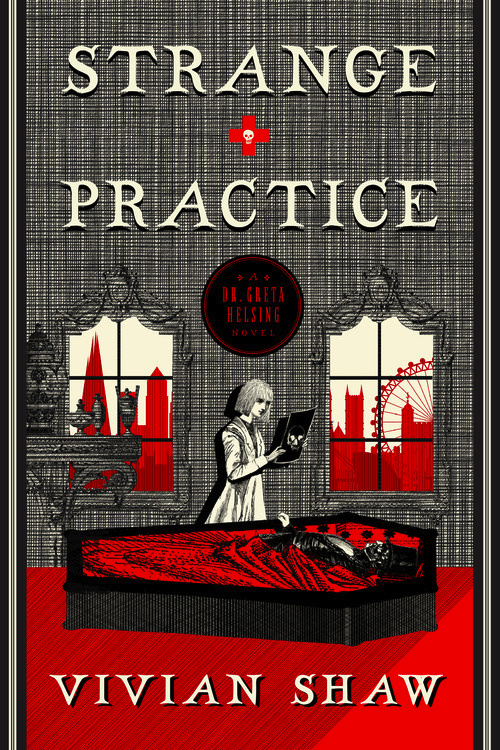
Round the corner from my house is a café that makes hot chocolate. That’s not unusual. But the way they make it is. They heat milk, pour it over chocolate chunks, add foam, and let you stir the chocolate in. It’s not the best way of making hot chocolate, but on a cold day, it’s still a tasty treat that does the trick of warming you up. I tell you this because the same is true of Vivian Shaw’s Strange Practice: it’s an inexpertly-made urban fantasy novel, but still enjoyable.
That might sound more condemnatory than I intend, so let me be clear: I enjoyed Strange Practice immensely, just as I enjoy the hot chocolate. But it is not without its flaws, and they are worth exploring.
Before delving into that, however, it’s worth summarising the plot. Greta Helsing (the family dropped the ‘van’ sometime in the 1930s) is a GP who looks after members of London’s hidden supernatural community. One of her colleagues is a witch. One of her best friends is a vampire named Lord Ruthven, who is lifted wholesale from John Polidori’s The Vampyre. When one of Ruthven’s friends Sir Francis Varney, similarly lifted from penny dreadful Varney the Vampire, is attacked, Ruthven and Greta become embroiled in a plot to exterminate the magical community. This plot is engineered by a malevolent primal force left over from the beginning of creation who, for reasons not strictly relevant, is currently housed in a disused underground railway mechanism from World War Two. It brainwashes priests from the nearby seminary into doing its bidding. When they aren’t killing random citizens and leaving rosaries on the body (leading tabloids to senstationally speculate about “The Rosary Ripper”) they go out with cross-shaped blades coated in a variety of tinctures and tonics designed to fatally harm magical creatures. Varney himself is stabbed with such a blade, and it is in healing him that Greta and Ruthven find themselves caught up in the evil being’s machinations. Along for the ride is August Cranswell, a human who works for the British Museum, and Fastitocalon, a demon with a penchant for accountancy. They duly defeat the evil being, with the help of Satan, but not before Fastitocalon has nobly sacrificed himself.
For me, the main flaw is that the characters are all, save for villain and the lackeys it brainwashes, incredibly and almost obsequiously nice. Not only does Greta leap into action to help Varney, a vampire she has never previously met, but so too do Fastitocalon and Cranswell fall over themselves to help as best they can in solving the main mystery. This is despite Fastitocalon’s respiratory difficulties, and the fact that Cranswell has hitherto never met any of the other protagonists. Furthermore, Greta’s involvement problematises her work at her surgery. But it’s OK, because her colleagues bend over backwards to help her keep it afloat. In amongst all this, she even finds time to help a family of ghouls look after their newest member, sick with a cough.
There’s nothing wrong with nice characters. But the niceness of Shaw’s protagonists is never given room to become a character flaw. Greta is stretched thin as a person – her responsibilities as a GP weigh heavily upon her, despite the slight income they afford her and the subsequent shabbiness of her lifestyle. But her colleagues step in and cover for her while she is off having an adventure, so these responsibilities never really hinder her. The only character who is harmed by their niceness is Fastitocalon. He rebuffs Greta’s concerns about his respiratory problems, but duly succumbs to them in the final battle.
Yet all is not lost, for almost immediately Satan himself comes riding to the rescue. Yes, you read that right, Satan appears from Hell and not only sends Fastitocalon down for some R&R (one can only imagine the restorative effects of a dip in the lake of fire), but is the only being that can truly defeat the big bad. Even Satan, ultimate symbol of rebellion and evil, whose name literally comes from the Hebrew word meaning ‘adversary,’ is made into a nice, almost paternal figure here. The theological implications for all this are brushed aside: Heaven and Hell do exist, but seek only to maintain order on Earth and try not to get too caught up in the lives of ordinary humans.
I’m not a Satanist, but I do enjoy stories involving Satan – I tend to term them “theological fantasy,” because I’m pretentious like that. I own the entire trade paperback collection of both the original Hellblazer series and the Sandman-spinoff Lucifer Morningstar, for example. Satan-as-a-nice-guy is an interesting concept, and if Shaw explores this further in later novels, I will happily set aside my dissatisfaction at his presentation in Strange Practice. But it rankled with me on first reading. Not only is he paternally nice, which is a slightly odd characteristic to give him, but his showing up at the end to solve the problem that the heroes couldn’t weakens the story as a whole. It’s literally a diabolus ex machina.
Beyond this main gripe, the story itself is actually quite fun. Barring some accidental Americanisms that belie Shaw’s US-based upbringing, life in London is depicted quite accurately. So too is the stress that Greta is under. Shaw makes sure that readers really do feel for the woman, stretched as she is between her obligations as a GP and her dedication to her supernatural friends. Plus, it is a refreshing change to enjoy a story in which the good guys are good and the bad guys are bad. There is a not-unwelcome growth in morally gray heroes and anti-heroes, and villains that readers love to hate and hate to love. I enjoy stories like that. It can, however, feel a little draining to always find oneself trying to excuse or contextualise a character’s nastiness or im/amorality. So, while having clearer black-and-white characters might come off as simplistic, it still makes for a pleasant read. And the plot is engaging enough that I found myself not wholly caring about the character deficits.
Is Strange Practice worth reading? Yes. If you enjoy urban fantasy of any variety, such as that penned by Neil Gaiman or Seanan McGuire, you will almost certainly enjoy it. It’s a fun romp, and an enjoyable novel to curl up with on a rainy day. And nice characters being nice to each other is always a pleasant experience. Hot chocolate can still be delicious, regardless of how it is made.
 A Passing Voyeur