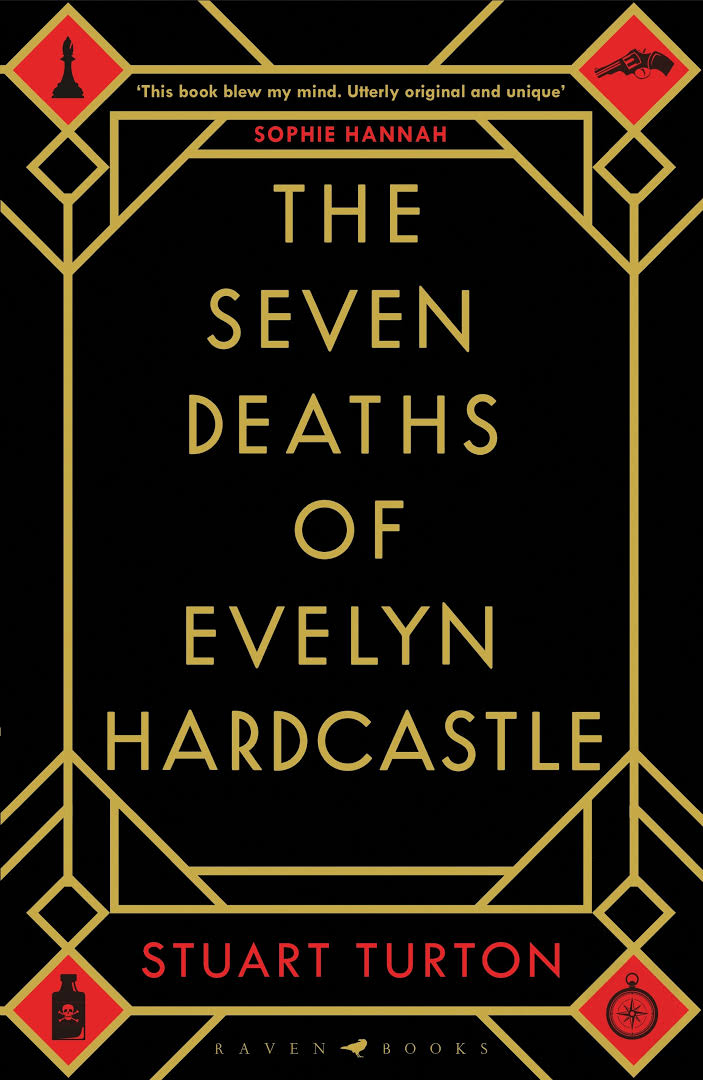
Crime fascinates me. Not so much in the true crime sense – my automatic reaction to the idea of “true crime” stories and podcasts is that they feel voyeuristic and sensationalist. But the idea of solving crimes fascinates me. I have thus enjoyed crime fiction for quite some time. Alas, I haven’t read proper crime fiction in a while. I used to devour airport-thrillers like those written by Jeffrey Deaver but, barring occasional dalliances, haven’t properly engaged with the genre since roughly 2014. I’m working to change this, slowly making my way through the John Rebus series by Ian Rankin. To this end, a friend gifted me a copy of The Seven Deaths of Evelyn Hardcastle by Stuart Turton.
Overall, the novel is great fun. The central premise is this: Aiden Bishop wakes up in a body that isn’t his own, and is tasked by a stranger in a plague doctor costume to solve the murder of heiress Evelyn Hardcastle at a party. Each day over the following eight days, he will hop into the body of a different party guest and must use whatever they have to offer in order to solve the murder. If he does not solve it, the whole thing resets and he must start again with no memories of his previous eight days. It’s an original and quite intriguing premise.
The estate of the Hardcastle family, Blackheath Manor, is very Gothic: a sprawling mansion, whose slow descent into ruin mirrors the hard times on which the Hardcastles have fallen. The bodies into which Aiden’s consciousness is transported are owned by suitably miserable characters. It’s told in a disordered fashion, each identity and different day recorded at the beginning of the chapter. All of this is very well-handled, the atmosphere of the novel is brooding and menacing, and the twists and turns deftly managed. The identity of the murderer I won’t reveal, but none of it played out as I expected it to which made for an enjoyable and engaging reading experience.
I did, however, take issue with the set-up. Not the idea of a body-hopping time-loop, per se, but the way in which that idea was utilised. Turton uses a man in a plague doctor costume to inform Bishop of the situation: that he has eight days, and eight bodies, with which to solve the death of the titular heiress, and he is in competition with two others. On its own, that’s a scintillating idea. A spooky guy forcing some other guy to solve a murder in a Gothic mansion? Sign me up. Great fun.
But. All is not as it seems. Turton later reveals that a time-loop prison company employs the plague doctor. Blackheath Manor is but one of thousands of time-loop simulations to which prisoners are condemned, their release contingent on them resolving whatever situation it is in which they find themselves. In this case, the condemned prisoner is Aiden’s love interest, Anna. She was sentenced to Blackheath Manor for killing his brother, and he has ended up in the Manor because he chased her in there to get his revenge. But, over the many years of the simulation, they have forgotten who they were on the outside. This is, of course, by design – the time-loops rehabilitate the prisoners into acceptable members of society, memory restoration optional upon release. Unfortunately, what should be a shocking twist doesn’t land with much impact. Given that Aiden knows nothing of his past on the outside, and neither does Anna, then it doesn’t really matter. Had Aiden kept his memories of his former life and still fallen in love with Anna, whose face could now be different to that which she’d worn before being imprisoned, and then been told his love interest was originally a murderer, that would have had more impact. Or it might have been obvious, depending on a given reader’s perceptiveness.
So, the novel hangs on two frameworks. One is a Gothic-horror-murder-mystery, the other a sci-fi dystopia for the ages, both mixed together into an intriguing plot that mostly works. Mostly. I feel as if Bishop and the plague doctor could have simply been a hero vs villain without the need for the plague doctor to be an employee in a prison system. As soon as we learn the plague doctor’s real name and his purpose, his mystique is gone. The menacing atmosphere of the novel is punctured, never to be fully recaptured. On his own, the mysterious plague doctor could have stood as a terrifying, unknowable enemy – an Iago manipulating Aiden for reasons never fully explained. Is Blackheath Manor a form of Hell? Purgatory? A nightmare? Is it real? We would never know, and so the plague doctor could rightfully take his place in the ranks of epic villains of literature. Instead, he is merely a jobsworth prison guard.
The same applies to the time-loop prison itself. What a concept! What a fantastic premise for a dystopia. There’s a whole universe here that Turton ignores: a gigantic cosmic playground in which we, the reader, see only a small game played out in one corner. Just on its own, a time-loop prison to which murderers are condemned until they have forgotten their former identities is a horrific punishment against which there would be no end of resistance. This is a fertile premise, offering potential commentary on prison reform and government corruption to virtual reality vs actual reality, AI problems, and more besides. What Turton does with it is an interesting use of the idea, but a limited one. Ultimately, it felt to me as if it doesn’t mesh well with the idea of a Gothic murder-mystery.
But don’t let this suggest that I didn’t enjoy it. This particular essay is more exploring a personal dissatisfaction than offering a proper critique. The time limit on the plot gives the story a frenetic pace, and Turton makes the reader really feel for Aiden, especially in some of his identities. Although we do not get much sense of who Aiden really is, the qualities of being a good man shine through regardless of his body. There is what feels like some unpleasant fatphobic language used when he is in the body of Lord Cecil Ravencourt, but I’m not qualified to comment on that issue; I just want to highlight as a legitimate shortcoming as opposed to my personal gripes. So, in sum, The Seven Deaths of Evelyn Hardcastle was a very entertaining read, regardless of my thoughts on its set-up.
 A Passing Voyeur